Exports –
Exports and imports are the two different sides of a coin. First let’s have a look what exports is all about and what are the things that India exports to other countries (we will stick to India only and will discuss everything in Indian context). So, exports are the goods and services that are produced in a domestic country and is sold to other countries. Since all the countries don’t have access to all the resources so there is always the need to either buy or sell the good.
For example: –
Since here we have assumed that we are exporting goods and services to another country which means that the other country is lacking that particular resources or maybe the particular good is not of good quality. Therefore, the other country will buy goods from us.
In layman’s language exports means to sell goods to different countries. India is the 17th largest exporter in the world. The key products which India exports are diamonds, pharmaceuticals, jewellery, rice etc. There are two things that makes a country good exporter: –
- Competitive advantage – a country exports only when they can produce goods better than the rest of the world so this gives them the competitive advantage.
- Comparative advantage: – it means when a country has resources to produce certain goods over other countries it gives them comparative advantage to produce that particular goods. India has a suitable climate to grow spices so it is a comparative advantage for India.
So, from the above things we got to know the basic information about the exports and now let’s look at the problems faced by Indian exporters –
- Government has a high amount of control over exports of India which means that there are a lot of restrictions through which the exporter loses their interest in exporting the goods.
- Due to inconsistent trade policies of India in comparison to the international trade policies it becomes very difficult to trade with India. The other countries think that there are a lot of contracts to be signed in order to trade with India.
- Increased import tariffs is also one of the reason which restricts the growth of our exports sector.
Current scenario –
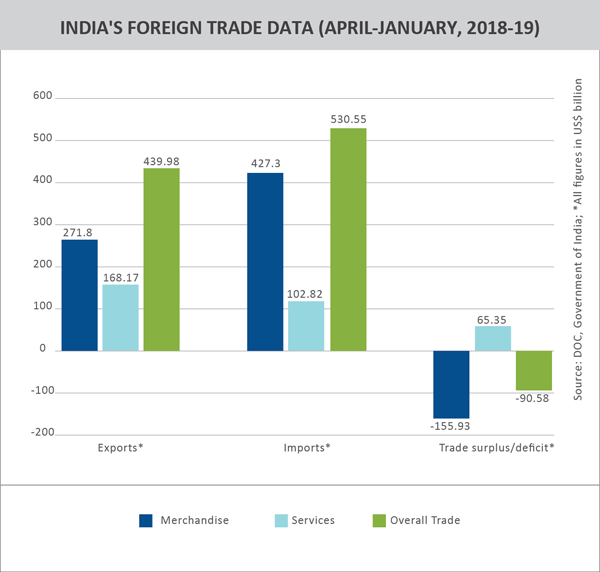
Indian exports are likely to register an all-time high record of $330 billion fiscal this year. This growth is mainly due to the pharmaceuticals, petroleum and engineering sector of Indian economy. In 2017 the exports were $302.84, and the highest was in 2013-14 – $314. In may steel export fell badly in comparison to the last three years. Annual growth rate of export should be 8-10% in order to give employment to new work force every year. If not, then this is a critical situation to focus on said chairman of NITI Aayog. There was an impressive economic growth in the year 2003-4 onwards and export rate was around 7% plus. Under Modi’s government the growth is 7.5% , which is pretty good but in order to generate more job opportunities export rate should be between 8-10%. Current export rate of 2018-19 is expected to be 9% with all-time high of US$325-330 billion.
How can we increase exports –
India has various strategies to capture the market internationally. Earlier trade was only considered to be merely a business deal or partnership but now the era has changed and now more focus is given on the relationship between the traders of two different countries. Unpredictable situations are happening like people have started questioning the existence of WHO, whether it should be there or not.
India’s strategy is to increase the exports by focussing on geographic specific and product specific matrix to expand globally. We not only want benefit but our global community should also get benefit. Ministry has also designed foreign direct investment of $100 billion from $61 billion in 2017-18.
Imports – so imports mean when a country buys goods and services from other countries in order to meet the demands of the consumers of the domestic country.
we had discussed earlier that all the countries face scarcity there is a need to buy and sell goods internationally and therefore imports take place. Let take an example that in India we don’t manufacture expensive and classic automobiles, therefore we import from countries like USA, Germany, etc. China is also the leading manufacturer of the world, the reason being the less cost of production. They are machine-oriented people and so they export to various countries. India is the worlds 11th largest importer in the world. Our respected PM Narendra Modi have said that we Indians should only use made in India products. We should support the domestic manufacturers; everybody is running after multinational brands just for the sake of status symbol. India imports various goods like oil, jewellery, heavy machineries, etc.
Current scenario –
Imports to India has increased by 4.31% from last year. The growth is majorly boosted by the purchase of gold and oil. On the other hand, the purchase of other commodities failed for example- pearls, vegetable oil, electronic goods, etc.
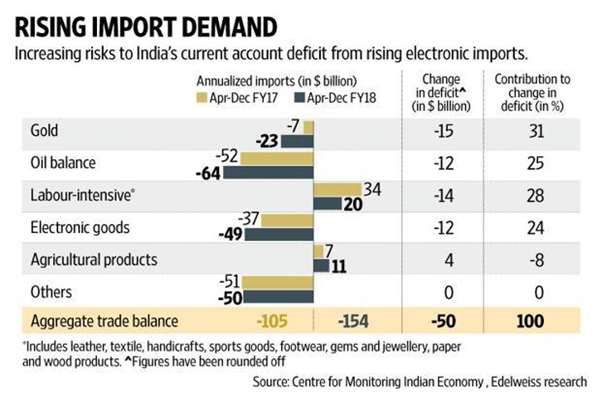
The above chart shows the increase in imports of electronic gadgets like mobile phones in the FY 2017-2018. In 2017 the net electronic imports increased by 12% compared to the previous year. The chart also shows that the deficit has reached $50 billion for April-December. It is 30% higher on annual basis. There is a lot of efforts being put by the policy makers, the competition among the manufacturers still remains a concern,” says Upasna Bhardwaj, an economist at Kotak Mahindra bank. The most important question is whether imposing high tariffs will help lowering the current account deficit? But all the economist has analysed the situation thoroughly imposing taxes won’t work here, the reason being mobile phones have become the status symbol rather than a device. People will buy it anyways so this is the situation of concern for many economists in the country.


 Mitali's Blog
Well written & provide full information
LikeLiked by 1 person